Man kan være enig eller uenig med forfatteren i mangt og meget, men emnet er interessant, kronikken er velskrevet og niveauet er alen over, hvad man kan finde i danske debatter om samme emner–hvis de da overhovedet findes. Her kommer nogle brudstykker:
“More than perhaps any other American political group, libertarians have suffered the blows of caricature. For many people, the term evokes an image of a scraggly misfit living in the woods with his gun collection, a few marijuana plants, some dogeared Ayn Rand titles, and a battered pickup truck plastered with bumper stickers reading “Taxes = Theft” and “FDR Was A Pinko.”
The stereotype is not entirely unfair. Even some of those who proudly call themselves libertarians recognize that their philosophy of personal freedom and minimal government can be a powerful magnet for the unhinged. Nor has recent political history done much to rehabilitate libertarianism’s image as an outlier.
The Libertarian Party’s paltry membership has never reached much beyond the 250,000 mark, and polling numbers for Ron Paul, the libertarian candidate the Republican presidential nomination, remain pitiable. Worse, despite Bill Clinton’s declaration that “the era of big government is over,” antistatist ideas like school vouchers and privatized Social Security accounts continue to be greeted with widespread skepticism, while massive new programs like the Medicare prescription-drug benefit continue to win the support of re-election-minded incumbents. A recent New York Times survey found increasing support for government-run health care, and both parties are showing signs of a populist resurgence, with demands for new economic and trade regulation.
And yet, judging by their output in recent years, libertarians are in a fine mood–and not because they are in denial. However distant the country may be from their laissez-faire ideal, free-market principles now drive the American economy to a degree unimaginable a generation ago. Former Federal Reserve chairman Alan Greenspan, who as a young economist sat at the knee of the libertarian guru Ayn Rand, presided in the 1990s over one of the most prosperous stretches in American history, with the support, no less, of a Democratic president. When the avowedly libertarian economist Milton Friedman died last November, he was lauded just about everywhere, and even given respectful treatment in places like the New York Review of Books.
Nor have libertarian victories been limited to the economic arena. Americans are increasingly laissez-faire in their attitudes toward sex, divorce, drugs and gay marriage. In the personal sphere as in the world of business and finance, freedom has become the guiding principle, especially for the young. As the motto of Reason magazine, the movement’s flagship publication, trumpets: “Free minds and free markets.”
… Doherty disabuses readers of the idea that libertarianism is exclusively concerned with economics. As he emphasizes, it has a political and moral dimension as well, “a vision of a radical and just future.” … Many of the figures described by Mr. Doherty believe that libertarianism is also good for the social fabric. Capitalism may not lead to the fraternité naively dreamed of by more conventional revolutionaries, but it does expand the circle of human trust beyond the traditional limits of family and tribe; social bonds thrive in an atmosphere of freedom. Indeed, several of Mr. Doherty’s subjects (particularly Hayek) argue that government meddling positively discourages the human instinct for association. If politicians and bureaucrats would get out of the way, people would more readily cooperate and support one another. As David Friedman (the anarchist son of Milton) concluded in studying the economics of tipping, people are capable of developing their own rules for distributive justice, and will pay for social goods of their own free will.
… Mr. Lindsey goes well beyond most libertarians in his claims for the moral benefits of the creed. In his view, it is not simply freedom that improves morals; it is the prosperity that follows in freedom’s wake. Wealth allows us to transcend “the cruel dilemma of lifeboat ethics,” in which scarcity prevails. Moreover, wealth expands human tolerance and imagination. Drawing upon the psychologist Abraham Maslow’s theory of the hierarchy of needs, Mr. Lindsey proposes that once people are confident of their survival and comfort, they feel free to pursue “postmaterialist values.” They have the time, energy and ease of mind to try to perfect themselves.
… Even on social and cultural questions, where libertarians have often tangled with tradition-minded conservatives, Mr. Lindsey is on to something in his talk of a “libertarian synthesis” combining self-expression and self-restraint. If the country was slouching toward Gomorrah for a while, it has at the very least straightened up a bit. Many of the indicators of social meltdown that received alarmed attention in the 1980s and early ’90s–high crime rates, “children having children,” teen drug use, rampant divorce–have improved lately.
But they have not improved nearly as much as one might wish–and it is difficult to separate the reasons for our abiding social disarray from the trends that Messrs. Doherty and Lindsey praise and for which libertarians bear a measure of responsibility. Despite Mr. Lindsey’s protestations to the contrary, libertarianism has supported, always implicitly and often with an enthusiastic hurrah, the “Aquarian” excesses that he now decries. Many of the movement’s devotees were deeply involved in the radicalism of the 1960s.
Nor should this come as a surprise. After all, the libertarian vision of personal morality–described by Mr. Doherty as “People ought to be free to do whatever the hell they want, mostly, as long as they aren’t hurting anyone else”–is not far removed from “if it feels good, do it,” the cri de coeur of the Aquarians.
… On the one hand, libertarians make a fetish of freedom; it is their totalizing goal. On the other hand, libertarians depend on the family–an institution that, in crucial respects, is unfree–to produce the sort of people best suited to life in a free-market system (not to mention future members of their own movement). The complex, dynamic economy that libertarians have done so much to expand needs highly advanced human capital–that is, individuals of great moral, cognitive and emotional sophistication. Reams of social-science research prove that these qualities are best produced in traditional families with married parents.
Family breakdown, by contrast, limits the accumulation of such human capital. Worse, divorce and out-of-wedlock childbearing leave the door wide open for big government. Dysfunctional families create an increased demand for state-funded food, housing and medical subsidies, which libertarians reject on principle. And in courts all over the country, judges who preside over the manifold disputes occasioned by broken families are forced to be more intrusive than the worst mother-in-law: They decide who should have primary custody, who gets a child on Christmas or summer holidays, whether a child should take piano lessons, go to Hebrew school, move to California, or speak to her grandmother on the phone. It is a libertarian’s worst nightmare.”

 Stiller fhv. vicepræsident Al Gore op som Demokraternes præsidentkandidat i 2008? De fleste ædruelige mennesker vil givetvis sige “nej” (og de fleste frihedsorienterede sjæle vil måske føle et koldt gys ned af ryggen). Prisen for en Gore future hos Intrade.com ligger da også p.t. på beskedne ca. 8.
 Blandt firsernes wannabe-yuppies med forkærlighed for in-your-face kapitalisme–og ja, der findes nok en enkelt eller to blandt Punditokraterne og vores læsere–var Gordon Gekko fra den ikke just særligt pro-kapitalistiske Oliver Stones 1987-film Wall Street om end ikke en helt så dog en slags ikon, som man på småpubertær vis kunne genere venstreorienterede venner og lærere med at idyllisere. Sådan en slags lavpandet John Galt.
 Med
Med  Som det muligvis vil være en stor del af vore læsere bekendt,
  I disse dage giver vennerne ovre hos
 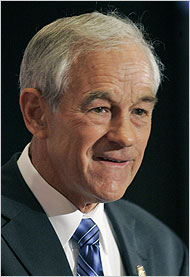 Tre-fire måneder før nogen danske MSM opdagede, at der blandt de Republikanske præsidentkandidater var et
  Ikke alle amerikanske libertarianere/liberalister er dog lige begejstrede for Ron Pauls kandidatur. En af de mest begavede akademikere, jeg nogensinde har kendt, er jura-professoren
  I går var 4. juli og dermed som bekendt årsdagen for en af de helt store begivenheder i frihedens idéers historie–vedtagelsen af den
  Novak–som jeg første gang bemærkede primo 1990erne, da han var med-vært på CNN’s “Crossfire”–har nu begået en bog om sine 50 år som journalist, herunder en politisk odysse fra venstrefløjen til … ja, der et sted, hvor nogle af os slår vore folder. Novak–der har været meget kritisk overfor Irak-krigen–er vel nærmest en slags paleo-konservativ med et undertiden kraftigt libertært islæt–om end han for postmoderne læsere vil være mere kendt for sin ikke-rolle i
  Med mig skal jeg også have
  Jeg har kraftig lyst til at sige,
